One of the great things about living in Europe is the myriad of vintage bicycles that can be found-- either locked to a bike rack, abandoned in an alley, or for sale on the local classifieds. In certain Dutch cities, you can even find them at the bottom of a canal, but retrieving them is best left to the city workers. Nevertheless, I can usually temper my enthusiasm towards owning these bicycles by admiring them and moving along, content in my understanding of their significance or lack thereof. Every so often, however, one will come along that I’ve never heard of, and then begins my journey into the murky world of now-defunct bicycle manufacturers. From Puch and Peugeot to Kettler and Kalkhoff*, there are dozens of brands that were manufactured before, between, and after the Wars, yet haven’t survived the 21st century.
One in particular caught my eye, firstly because of it’s design and secondly because of it’s name. In regards to the former, I’ve been wanting a “proper Dutch bike” since we moved here, and hadn’t got around to finding one that suited my taste. Sure, it’s socially acceptable for men to ride a step-through here, but in my mind, I wouldn’t be able to reconcile that with the fact that they are called omafiets to differentiate them from the horizontal top tube of an opafiets, that is, a bicycle for distinguished grandpas. Also, black is the most common color of Dutch bikes, with Day-Glo orange, polka-dot, and Grimace purple coming in at a close second, so to find an understated silvery grey was a bit exhilarating. As to the name, well, my English-speaking brain found it amusing.

Pronounced “yoon-kerr”, like the current President of the European Commission (as if that helps anyone reading this), Juncker was established in 1898 in the Dutch city of Apeldoorn, which is also home to another bicycle manufacturer called Sparta, one of the largest and most well-known bike and moped companies in the Netherlands. In 1968, like several other competing companies, they were bought by Gazelle and brought under as a subsidiary brand.
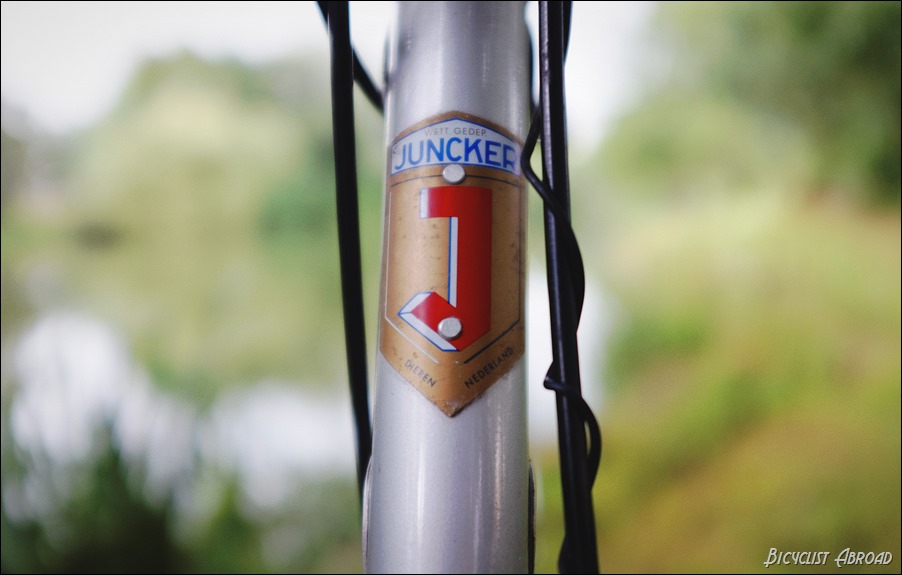
These subsequent “Gazelle Junckers” were basically Gazelle’s with the Juncker branding, and perhaps, some less premium components. This model, the Tour de France, is more or less identical to the Gazelle Tour de France released in the later half of the 1970s. Also similar is their inherent inability to be used in the actual Tour de France, but let’s assume the name is short for “Wine Tour de France”, which makes a lot more sense.

Name aside, the build is solid as any Dutch bike should be, with some very elegant and understated touches. The full chain case is absent in favor of a partial chain case and a 5-speed rear derailleur. Drum brakes are used on both the front and rear hubs, and a bottle dynamo powers both the headlamp and the rear, fender-mounted light. A frame pump sits snugly against the downtube, and the handlebar grips have a very pleasant knurl to them.

Tiny little gazelles adorn many of the bolts and bits, as is customary for Gazelle bicycles, and the seat tube decal features the Gazelle logo as well. As to whether the Juncker name or the Gazelle branding carried more weight at the time, I don’t really know, but it is very clear that this line was an amalgamation of both brands. There is no date stamped anywhere on the frame, and Gazelle have changed their serial numbering once or twice over the years, but my best estimates put this particular bicycle as being made in 1976.

Interestingly, before I had a chance to test ride the bike, I thought to myself, “hmm, I’ll probably replace the saddle with the Brooks B17 or even the sprung B130 I have.” They seemed to agree with the general aesthetics and intended use of this bike. But after the seller allowed me to take it for a spin, I found the stock saddle to actually be pretty comfortable, at least to the degree that I didn’t think it needed to be swapped out. Sure enough, I get off of the bike and find a familiar name embossed on its exterior.

I’ve found almost no information about this type of Brooks saddle, and only a couple images on the Internet of other bicycles having them. It’s some type of plastic-covered foam, but it still has the signature bag loops on the back and steel support rails underneath. Other than “Made in England”, I’ve yet to find anything indicating it’s manufacture date, so I don’t know whether it is original to the bike or not. Either way, it doesn’t require an application of Proofide and is rather water resistant, so I think I’ll leave it be.
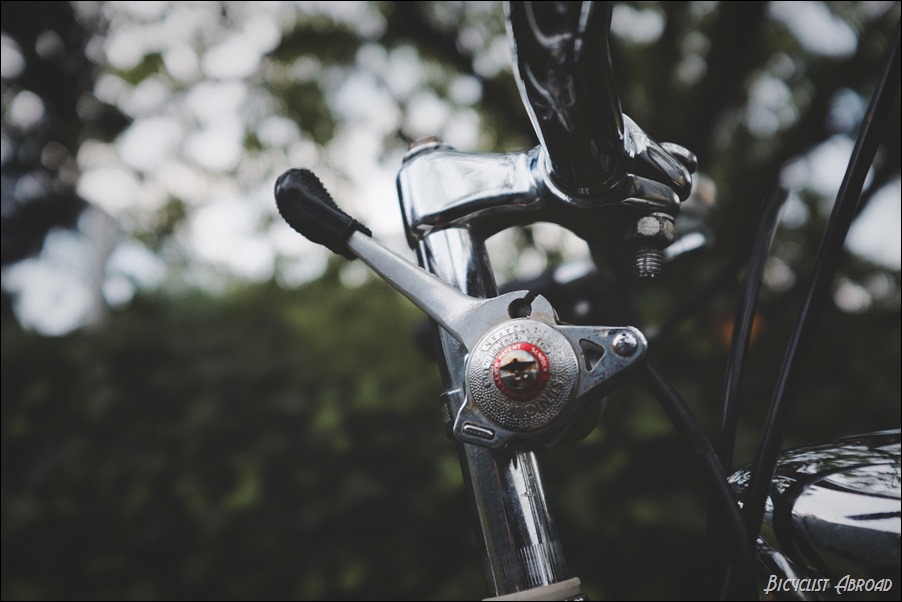
Shifting is performed by a Suntour lever mounted to the stem, non-indexed as changing gears ought to be. Like many Dutch bikes, stability and control are such that one-handed operation is often more than adequate.

So I’ve finally found my Dutch bike, the one that I can ride around town for pleasure or toss on a couple panniers for a grocery run. The one that can throw a soft light ahead of me when it gets dark courtesy of the electricity generated by my spinning wheels. The one that actually blends in with every other bicycle out there instead of attracting unwanted attention (note: bakfiets are great conversation starters!). As I’ve stated elsewhere, if I had to just have one bicycle, this would be it. Not because it excels at everything—far from it, actually. This would be a terrible bike for off-road or touring—but rather, like the Japanese mamachari, it suits the utilitarian, classy, and functional style of riding that I appreciate more than anything else. It may be a Juncker, but it’s my Juncker.
- Bicyclist Abroad
*Kalkhoff still manufactures bicycles in Germany, but they used to, too. Ya dig?

 The plan was hatched at a friend’s house over a couple beers— why don’t we just ride from here to Berlin Bicycle Week? We could leave on a Sunday and make it there by Thursday if we kept a fairly quick pace. 650 kilometers over five days: riding, camping, and a then a huge bicycle expo. Why not?