Showing posts with label Germany. Show all posts

14 December 2016

The Rur by Rad, Pt. II

dscf5484_29006601884_o

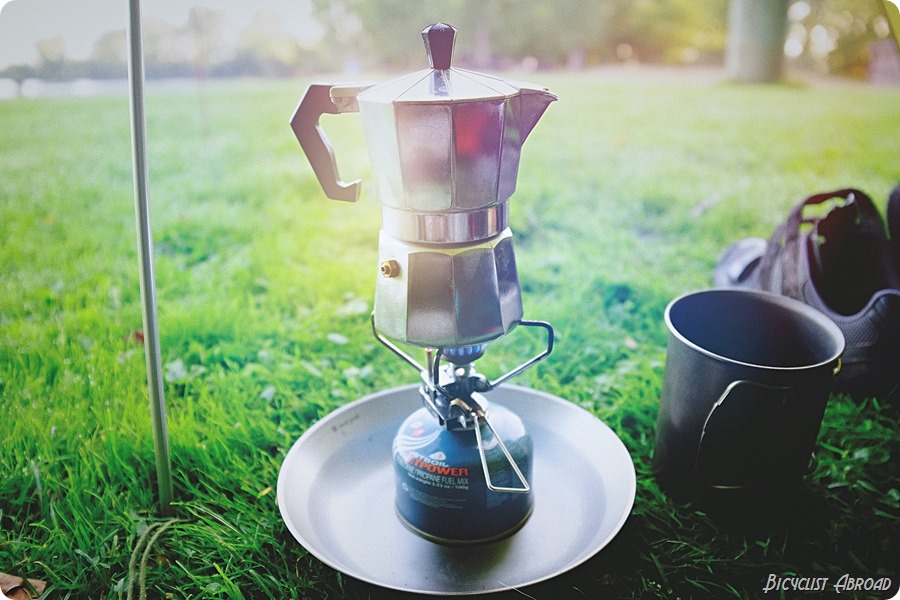
The next morning a fine mist settled over the lake, and after some coffee, I got up to lay out everything to dry in what little sun was available. I underestimated the amount of moisture that would accumulate in an open tarp tent setup, but my bag was still dry inside a bivy sack so that’s all I was really concerned about. Noticing that my coffee tasted particularly bad, I check the water coming out of my filter and it was turbid, pretty much exactly the color of the water I was getting out of the lake. I guess at some point since I last used it, the filter had froze and was compromised. Looked like I’d be buying my water the rest of the journey.
dscf5438_29632913885 

Once on my bike, I spent the rest of the morning winding through the streets of Düren trying to find my way back to the river. There was an access point behind some buildings that lead to the river trail, where I was soon departing the city and riding into more rural landscapes. I did stop at a gas station to fill up with water and get some snacks for the ride, and the lady working there was nice enough to give me the .25 cent deposit back on the bottle after I emptied it.

dscf5429_29342133210_o

Less than thirty minutes of riding later, I discovered that the route passes right through a campground, something that would have been great to know the day before. That’s the price you pay, I suppose, for just winging it. Sometimes you end up on top, sometimes you miss out. In any event, I did get to see this Pirate/Santa Claus garden gnome that was hanging out by one of the more permanent residences at the campground, and that was pretty cool.

dscf5456_29632830555_o

A couple bridges, some paved sections, and some dirt, but mostly flat terrain and easy riding for most of the way down to the next major town. The river was only a few centimeters below the trail at some parts, and I wondered if the trail flooded during heavy rains. I spotted a few people fishing, a couple people letting their dogs enjoy the water, and one person sitting alone and drinking a bottle of liquor. People come to the river for many things.

dscf5445_29342077360_o 

dscf5450_29597756536_o_

Soon I was entering the Eifel National Park, and almost immediately the scenery, and the elevation, drastically changed. Gone were the pastoral rolling hills and farm fields, replaced by densely forested mountains and valleys. The route diverged into mountain-bike singletrack and a less-challenging, yet still unpaved path; as much as I wanted to have some fun in the dirt, I had a long ride ahead of me and opted for the easier course. The other thing that stood out to me was that the Rur was no longer in sight—the route and river wouldn’t converge again for some time, and I questioned whether all this climbing through the woods was necessary, as the river itself was somewhere far below. After getting back on pavement that snaked up a hillside resort for no apparent reason, I solidified my reservations with the German route planners. Little did I know that I had much, much more climbing ahead of me.

dscf5522_29341868890_o

I knew before setting out that by going north to south I would be gaining in elevation, but I didn’t realize just how much of a climb I was in for. All of a sudden, I understood the German obsession over e-bikes, or pedelecs, as I cranked up a climb with everything I had, only to be passed by a couple of Golden Girls wearing flip flops. Several minutes later I met up with them at a vista at the top of the hill, and they gave me a look like “isn’t it a lovely view?” and I gave a look like “Oh God, I can’t breathe right now.” At any rate, the scenery is more beautiful the harder you work to get there. That’s my mantra, and I’m sticking to it.

Actually, let me amend that last statement. There’s a certain threshold where the struggle is worth the payout, and I quickly found myself beyond that margin into the land of diminishing returns. Coming down a fun descent into the riverside town of Rurberg, I was faced with the decision to continue the officially sanctioned Rur Route to Monschau, my destination for that day some 21 kilometers away at a 9% grade, or a shorter, slightly easier road into Simmerath, a neighboring town at 7% and only 8.9 kilometers away. Naturally, I chose the latter, having no idea what a 7% grade translates to in terms of steepness.


dscf5537_29006473494_o 

Half a dozen hairpin turns like the one above awaited me. Motorcyclists were buzzing up and down like it was Disneyland, a pretty good indicator that this road was a lot more fun for certain forms of transportation than others. I was in the lowest possible gear, spinning away and cursing the route planners that decided this was a suitable road for a national cycling route. It was grueling.

dscf5542_29551644961_o 

dscf5549_29551642441_o

Finally out of the valley and atop a plateau, I took a few minutes to appreciate the view and catch my breath before continuing on. This region was so picturesque with its rolling pastures and century-old farmhouses that I wanted to set up camp in a field next to some grazing sheep, but I doubt the farmer would have been on board with that. Instead, I rode for several kilometers into Simmerath, intending to find somewhere there to spend the night.

Interestingly, once I arrived at Simmerath, I began to see signs for Monschau, only these said it was eight kilometers away. I’m not the best at math, but I know I rode just under nine kilometers to get here, and it’s another eight to Monschau for a total of 17km which is a pretty big difference compared to the Rur River Route that would have taken me up a mountain pass at a 9% grade for 21 kilometers. Are you serious?, I thought to myself. Why would anyone opt for that route? 

dscf5554_29551636621_o

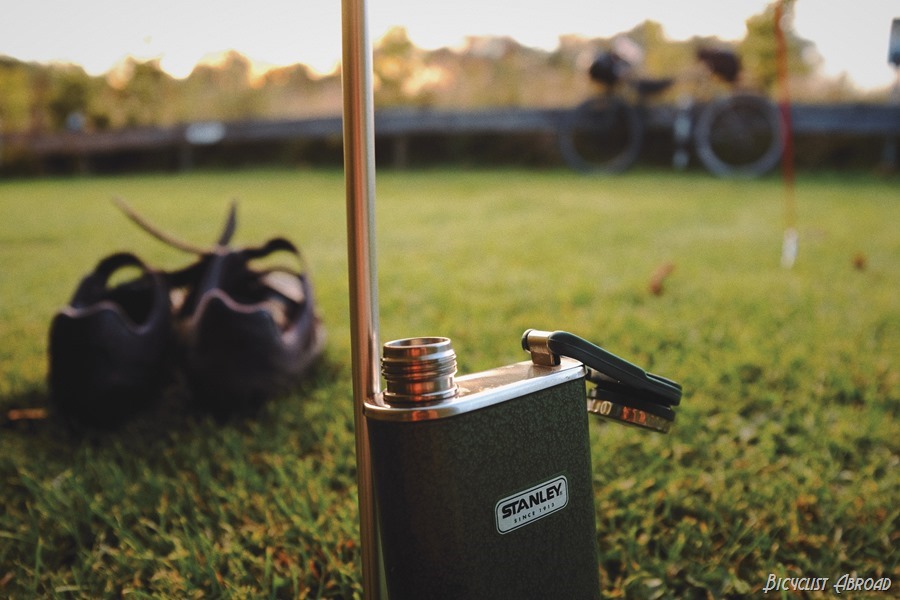
So I found a campsite just outside of the Monschau city limits and set up my tarp tent in the dwindling sunlight. I hadn’t touched my flask up until this point, but I felt like I deserved it after all I contended with that day. A friendly Dutchman with an RV also offered me his shower token, either because his RV already had a shower or because it looked like I needed one, but I was thankful either way. I got settled in to my sleeping bag and reflected on everything I’d seen that day, with my final day of the trip and the end of the Rur River Route ahead of me.
dscf5556_29551635091_o 

- Bicyclist Abroad

BA Post Footer

17 October 2016

The Rur by Rad, Pt. I

By The Bridge in Vlodroop

With summer winding down to its last few weeks I had one last bike trip to get out of my system. My grandiose plan of riding the Rhein from start to finish had condensed into a trip of much smaller scale, albeit still centered on following a river; this one was called the Rur.

Basically, the plan was to follow the Rur from where it crosses the Dutch/German border down to Monschau, then take the Vennbahn from there to Aachen, and finally, the Zweiländer (two countries) Route back home, completing a circuit on pre-existing German cycling routes. Like the Rhein, the Rur flows from south to north and so the route I was taking was “uphill” even though the elevation changes were imperceptible, at least not for the majority of the route. Were you to follow it from start to completion, it would take you from Belgium, through Germany, and into the Netherlands.

As my first foray into German National Cycling routes, I was just going to see how it played out, and worst case scenario I had areas maps and a smartphone with GPS that could orient me towards the nearest train station. Following the green and blue markers (see below) depicting a winding river, the route was a fairly straightforward ordeal.

RurUfer Waypoint Sign

Except when it wasn’t. There were a handful of times a sign would have been helpful, but I was on my own in determining the right direction because they were either absent or obscured. Luckily, heading towards the river, or where I thought the river would be, was an effective means of getting back on track.

Elmo

From Vlodroop, the Dutch border town where I picked up the route, to Linnich some 40 kilometers later, the path was mostly gravel with wooden or concrete bridges that switched back over the river periodically. This was ideal terrain for the bike I was riding, and I was pretty happy with both its handling and ride comfort. I’d never done the front pannier thing before, and it wasn’t bad once you got up to speed.

In one particular area, you could tell they had just laid down new gravel because it was quite abundant, to the point of excess. Curbs of gravel formed on both sides of the trail. I was swimming in tiny stones.

plenty of gravel

After Linnich, the next major city was Jülich, an industrial town rebuilt after the war with a decidedly 1970s feel. The river route deviated from the actual river here and instead snaked through residential roads and paths in and out of forested areas. I had contemplated staying the night in Jülich, but couldn’t shake the weird vibes and continued on my way.

entrance to nothing

Eventually, the River Route and the Rur reunited. Idyllic countryside and the sound of a slow current made for a relaxing ride. I met one couple on the trail who were on their way to Rome, which if you’re not sure, is nowhere close by.

on the bank of the  rur

x

At my signature pace of slightly above a leisurely jaunt, the evening was closing in and I needed to find a place to spend the night. A Teepee icon on a waypoint map indicated there was a camping spot next to a lake just outside of Düren, so I decided I’d try my luck there.

Arriving in Düren, I really didn’t see too much of the city aside from the city park and a giant pair of spectacles.

giant spectacles

The signs at this point were seemingly contradictory, and I spent  quite a while trying to ascertain which direction I needed to go. A man without the use of his legs sat drinking at the park entrance and was amused by my repeated checking of signs. Heading west, I saw signs for a “Badesee” which I assumed was the same lake that the camp ground sat on, so I followed those signs for roughly 5 kilometers outside of town. Upon arriving to the lake, an employee kindly informed me that the lake I was looking for was not this one. She gave me general directions to the campsite, and it wasn’t until I thanked her and was leaving that I realized the conversation had transitioned from German into English at some point.

Maybe 20 minutes later, I was at the right lake but didn’t see any places to camp other than an RV park. There was no office either, just some people working behind a café counter. I asked one of them about camping, and they told me to pick a spot anywhere on the grass, as long as it was out of the way. Also, I could use the showers at the RV park because the ones closest were cold water only. 9 Euro for the night, and I was welcome to eat at the café whenever I was hungry.

testing the tarp tent

I pitched my tarp tent and stretched out for a minute before calling the Mrs. to check in getting a bite to eat. I was the only camper, and when the lake visitors and the staff all went home for the day, I had the entire place to myself. Rather than feeling lonely, it was really rather peaceful and if I had brought something to swim in (or a means of drying the clothes I had) I would have done a bit of solitary swimming. But instead, I read a couple chapters of an e-book on my phone and fell asleep, dreaming of the adventures tomorrow might hold.

lake after closing

*Something new!*  First time I’ve tracked a ride with an app, feel free to trace my route below:


- Bicyclist Abroad


BA Post Footer

30 June 2016

Scenes from the Stadt [Hamburg]

Batavus Train Station

Neshanne and a couple friends were running a half marathon in Hamburg this past weekend, so along came I and the little one to visit the historic city and be a spectator to the race. Upon arriving, we checked in and waited for our friends who had driven separately. Apparently, they had gotten caught in the Hamburg Critical Mass, which for those who aren’t familiar with the term, is a very large gathering of bicyclists that more or less take over the streets to promote awareness of social issues or just to celebrate bicycle culture. Too bad we just missed it!

gov bldg hamburg

Hamburg is an interesting place historically, architecturally, and geographically. Prior to 1871, it was it’s own country. Now, it is both the second-largest city in Germany and its own federal state-- so it has its own identity outside of Germany proper. I knew it as the place the Beatles got their start, and I suppose, the birthplace of what would become an American food staple.

Riding past the Beatles

While I never got the chance to do any cycling there myself, there were plenty of bicycles to look at as we strolled along different parts of the city. We visited the Reeperbahn, or the famous “Red Light District” of Hamburg, found the Beatlesplatz (you can sort of make out the silhouettes of the Fab Four in the photo above), and took the U-Bahn to the Rathaus, or city hall, in the Altstadt.

Hamburg Harbor

The Elbe River runs through the city, as it was an important trade route from Europe to the rest of the world and made Hamburg what it is today. Canals abound, but we decided to check some of those out the next time we visited the city. There was simply too much to see in one weekend, and the weather was often uncooperative.

Radisson Hamburg

While maybe not as bike-friendly as Münster, Hamburg is bustling with bicycles, especially around the university, near where we had stayed. And like many cities in Europe, many abandoned bikes have accumulated over the years, some missing their more valuable components or becoming permanent installments on the street. We ate at a burger joint (had to partake in the city’s namesake food, even if it was a veggie burger) that was beside a cargo bike shop that featured all sorts of interesting and unique cargo bikes. They are really becoming a common sight outside of Dutch and Danish metropolitan areas.

Hamburg Streetshot

rain on bikes

Not having ridden there myself, I can’t say for sure how good the cycling infrastructure is, but it has to be better than Düsseldorf, a city I love in spite of its magically disappearing bike lanes. While the ADFC ranks Hamburg as the 35th in cycling safety, Copenhagenize ranks it 14th overall in its list of bicycle-friendly cities, due in part to its extensive cycling strategy, implemented some eight years ago by the Hamburg Parliament.

Searchlight bike

Also of note is the Vattenfall Cyclassics, Germany’s only UCI race, which is hosted in the city each year and involves a huge swath of participants, exhibitors, and spectators, including a children-specific event called the Schul-Cup. The Jedermannrennen is an event in which anyone can partake. More information about Hamburg’s cycling efforts can be found on the UCI’s website.

Not cycling-related, but if you’ve ever wondered where the world’s largest model train diorama is, that’s in Hamburg, too.

- Bicyclist Abroad


BA Post Footer

18 June 2016

A Gazelle By Any Other Name

Juncker by the Pond

One of the great things about living in Europe is the myriad of vintage bicycles that can be found-- either locked to a bike rack, abandoned in an alley, or for sale on the local classifieds. In certain Dutch cities, you can even find them at the bottom of a canal, but retrieving them is best left to the city workers. Nevertheless, I can usually temper my enthusiasm towards owning these bicycles by admiring them and moving along, content in my understanding of their significance or lack thereof. Every so often, however, one will come along that I’ve never heard of, and then begins my journey into the murky world of now-defunct bicycle manufacturers. From Puch and Peugeot to Kettler and Kalkhoff*, there are dozens of brands that were manufactured before, between, and after the Wars, yet haven’t survived the 21st century.

One in particular caught my eye, firstly because of it’s design and secondly because of it’s name. In regards to the former, I’ve been wanting a “proper Dutch bike” since we moved here, and hadn’t got around to finding one that suited my taste. Sure, it’s socially acceptable for men to ride a step-through here, but in my mind, I wouldn’t be able to reconcile that with the fact that they are called omafiets to differentiate them from the horizontal top tube of an opafiets, that is, a bicycle for distinguished grandpas. Also, black is the most common color of Dutch bikes, with Day-Glo orange, polka-dot, and Grimace purple coming in at a close second, so to find an understated silvery grey was a bit exhilarating. As to the name, well, my English-speaking brain found it amusing.

01-poster-junckerfabriekenkl_lbb

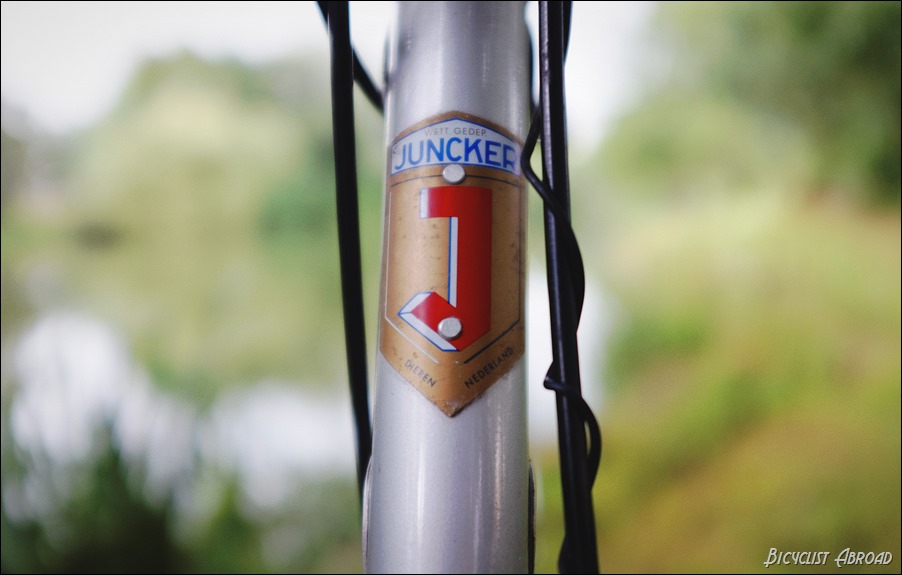
Pronounced “yoon-kerr”, like the current President of the European Commission (as if that helps anyone reading this), Juncker was established in 1898 in the Dutch city of Apeldoorn, which is also home to another bicycle manufacturer called Sparta, one of the largest and most well-known bike and moped companies in the Netherlands. In 1968, like several other competing companies, they were bought by Gazelle and brought under as a subsidiary brand.

Juncker Headtube Badge

These subsequent “Gazelle Junckers” were basically Gazelle’s with the Juncker branding, and perhaps, some less premium components. This model, the Tour de France, is more or less identical to the Gazelle Tour de France released in the later half of the 1970s. Also similar is their inherent inability to be used in the actual Tour de France, but let’s assume the name is short for “Wine Tour de France”, which makes a lot more sense.

Juncker profile 2_Fotor

Name aside, the build is solid as any Dutch bike should be, with some very elegant and understated touches. The full chain case is absent in favor of a partial chain case and a 5-speed rear derailleur. Drum brakes are used on both the front and rear hubs, and a bottle dynamo powers both the headlamp and the rear, fender-mounted light. A frame pump sits snugly against the downtube, and the handlebar grips have a very pleasant knurl to them.

Juncker Gazelle Logo

Tiny little gazelles adorn many of the bolts and bits, as is customary for Gazelle bicycles, and the seat tube decal features the Gazelle logo as well. As to whether the Juncker name or the Gazelle branding carried more weight at the time, I don’t really know, but it is very clear that this line was an amalgamation of both brands. There is no date stamped anywhere on the frame, and Gazelle have changed their serial numbering once or twice over the years, but my best estimates put this particular bicycle as being made in 1976.

Juncker Seat Tube

Interestingly, before I had a chance to test ride the bike, I thought to myself, “hmm, I’ll probably replace the saddle with the Brooks B17 or even the sprung B130 I have.” They seemed to agree with the general aesthetics and intended use of this bike. But after the seller allowed me to take it for a spin, I found the stock saddle to actually be pretty comfortable, at least to the degree that I didn’t think it needed to be swapped out. Sure enough, I get off of the bike and find a familiar name embossed on its exterior.

Brooks Mystery Saddle

I’ve found almost no information about this type of Brooks saddle, and only a couple images on the Internet of other bicycles having them. It’s some type of plastic-covered foam, but it still has the signature bag loops on the back and steel support rails underneath. Other than “Made in England”, I’ve yet to find anything indicating it’s manufacture date, so I don’t know whether it is original to the bike or not. Either way, it doesn’t require an application of Proofide and is rather water resistant, so I think I’ll leave it be.

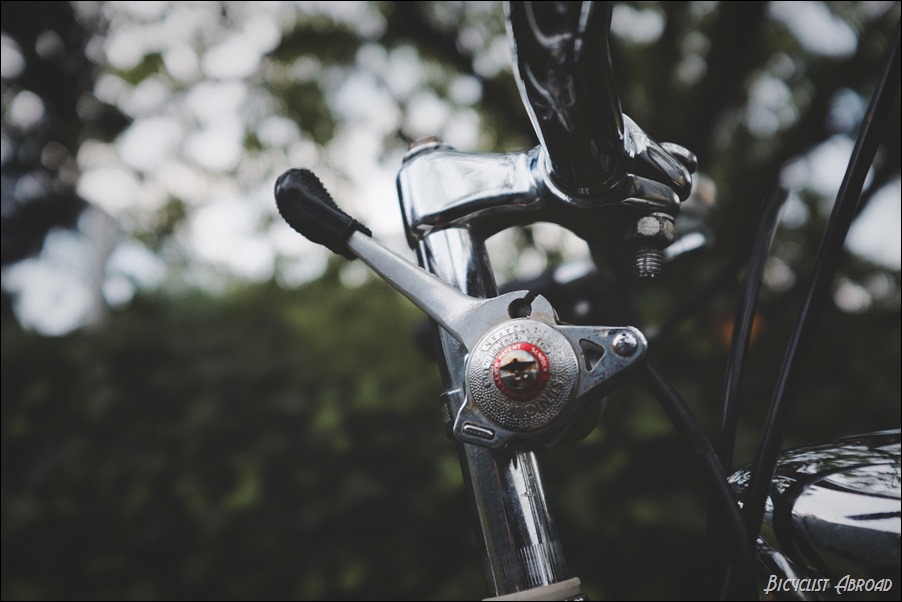
Juncker Shifter

Shifting is performed by a Suntour lever mounted to the stem, non-indexed as changing gears ought to be. Like many Dutch bikes, stability and control are such that one-handed operation is often more than adequate. 

Juncker on the road

So I’ve finally found my Dutch bike, the one that I can ride around town for pleasure or toss on a couple panniers for a grocery run. The one that can throw a soft light ahead of me when it gets dark courtesy of the electricity generated by my spinning wheels. The one that actually blends in with every other bicycle out there instead of attracting unwanted attention (note: bakfiets are great conversation starters!). As I’ve stated elsewhere, if I had to just have one bicycle, this would be it. Not because it excels at everything—far from it, actually. This would be a terrible bike for off-road or touring—but rather, like the Japanese mamachari, it suits the utilitarian, classy, and functional style of riding that I appreciate more than anything else. It may be a Juncker, but it’s my Juncker.

- Bicyclist Abroad


*Kalkhoff still manufactures bicycles in Germany, but they used to, too. Ya dig?


BA Post Footer

17 May 2016

What Might Have Been [Berlin Bicycle Week #3]

sitting on the wall

Having spent the night in our hammocks, I thought that perhaps my knee would have benefitted from being elevated all night long. Standing up the next morning proved me wrong. I gave it a chance and hoped that as I warmed up, the pain would lessen and we could cover some distance. I really didn’t want my knee to be the central focus of our trip, but every pedal stroke was a reminder, forcing me to question whether it was a good idea to keep riding on it, or if I should throw in the towel and buy a ticket on the Deutsche Bahn.

will morning shot

Wolfsburg was just a few kilometers down the road from where we had camped, but we opted to follow the canal again which would bypass some of the more industrial parts. Home to Volkswagen, it is a medium-sized city that is centered around the German auto industry. Notwithstanding, we were still able to find a bike shop so that Will could buy new 29er tubes. Interestingly, the bike shop only sold electric mountain bikes—not something either of us imagined would be very profitable considering it being such a niche product. But then again, I wouldn’t have expected Nordic walking or The Simpsons to be so popular amongst Germans either, so you never really know.

We rode into the centrum so that I could get some Ibuprofen at the drug store and to get some lunch. A small pizzeria caught our interest so we sat there and ate, got some beers, and ruminated over our next move. Ultimately, I decided that I could keep riding if we stayed at the pace we had ridden this morning— it wouldn’t get us to Berlin, but we’d get as far as we could before we had to find a train station to take us the rest of the way.

will east west border

Somewhere along the line we came across one item we were hoping to find—a sign signifying the former border between East and West Germany. “Here, Germany and Europe were split until 6 a.m. on December 23rd, 1989” reads the sign. We also came across two hitch hikers who were, for all we could tell, looking for a ride in the middle of nowhere.

map check

As we rode into what would have been a completely separate country 27 years ago, I wasn’t sure if it really did feel different or if was all in my head. The streets seemed wider, the houses were built a little differently.

We stopped at a small park to check our progress, or rather, Will checked his GPS and I wandered around looking at things and taking photos. There was a World War I memorial with an inscription that I’m well familiar with, though to see it in another language and in the context of another country’s armed conflict, it really put into perspective the tragedy our enemies had endured as well.

niemand

“No one has greater love, than he who would lay down his life for his friends.”

We came to the conclusion that we probably had enough daylight to ride to the area we would call camp for the night, and if not, well we’d just set up in the dark. We left the little town we were in and continued east, riding through a couple of smaller villages and roads with little to no traffic. After a while, we stopped to check our progress again in the village of Miesterhorst, and decided that where we were actually looked like a good spot. As a bonus, a sign indicated that the train station was just across the street, so we could catch the train in the morning and be on our way to Berlin.

 campcandle

The skies were clear and it was a crisp night. The limits of my sleeping setup were tested and exceeded- I ended up “going to ground” in the middle of the night, undoing the end of my hammock and laying on the ground to forego comfort in exchange for a little more warmth. Needless to say, I was really looking forward to the morning’s coffee.

dscf3210_25958411715_o

After breakfast and we broke camp, we made our way across the road to the train station. Things began to look questionable as we approached a dilapidated brick building with smashed in windows and an overgrown train platform. Clearly no one had worked here in decades, but did the train still stop here? There wasn’t anywhere to purchase tickets, and after some deliberation, we decided it would be best to ride to the next town and catch the train there. My knee didn’t agree, but it was that or wait here for an unknown amount of time, and even then who knew if the train would stop for us.

abandoned station

So we rode on towards the next town of Mieste, about 8 kilometers out. We were relieved to find a ticketing kiosk and other people there. Two people tickets, two bicycle tickets, and we had secured the final leg of our trip.

The weather was beautiful that day, and there was hardly any wind. I couldn’t help but think about what might have been if I didn’t screw up my knee on the very first day of our trip. We would probably be able to ride right into Berlin, the Brandenburg Gate a symbolic finish line worthy of our accomplishments. Instead, we ambled along and I needed to stop with increasing frequency to deal with the pain. Will reassured me that he wasn’t disappointed and was still having a good time, so I decided to adopt the same attitude.

refugeeswelcome

An interesting, yet not unexpected sentiment I kept seeing displayed on stickers, written on walls, and in graffiti was the inclusion of refugees and the shunning of Nazi sympathizers, which is apparently still an issue. That, or those opposing the refugees are being called Nazis. Either way, “Nazis verpisst euch!” above translates roughly to “Nazis f*ck off!”

berlin wall

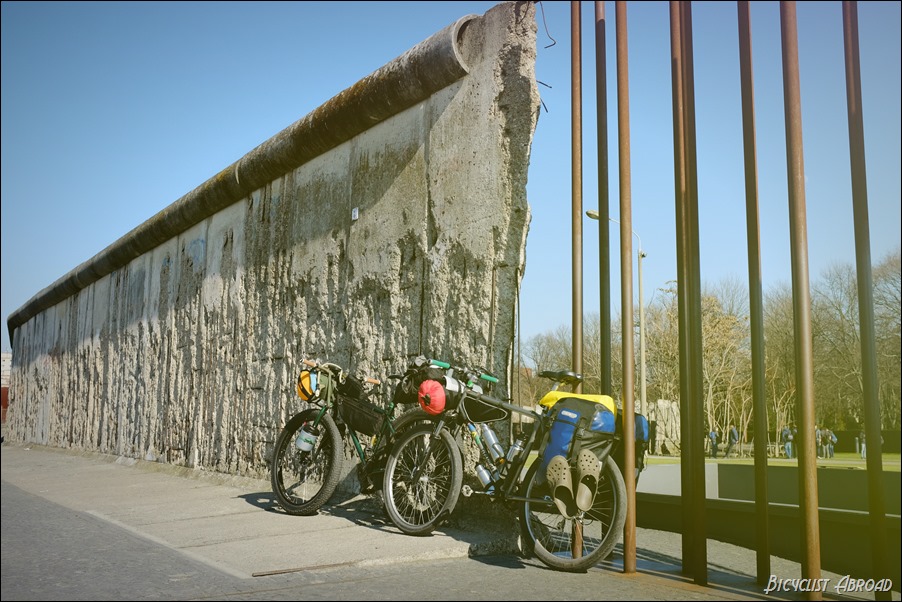
Arriving at the Berlin Hauptbahnhof, we gathered ourselves together for what would be, at least for me, the last ride for quite a while, as I needed to begin the lengthy process of waiting for my knee to heal. Along the way to our accommodations, we were so caught up in the rare Berlin sunshine that we almost passed right by an intact portion of the Berlin Wall. There it stood, a relic from a bygone era, now serving as a memorial to the victims that died trying to escape from it and a reminder of what might have been.

- Bicyclist Abroad

BA Post Footer